
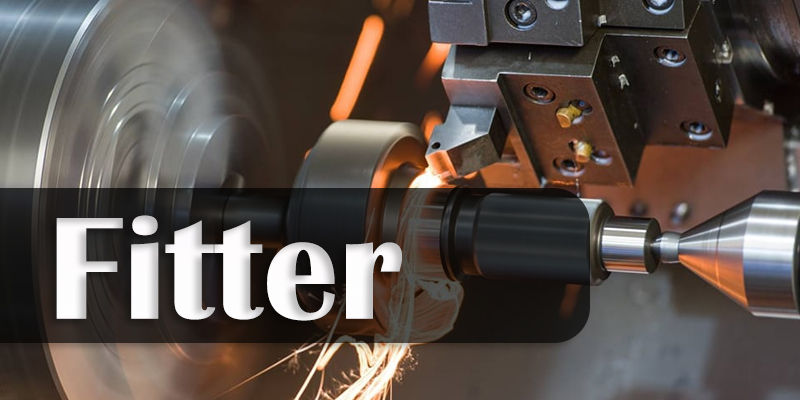
FITTER Job Role
The Fitter trade is an essential occupation in the mechanical and manufacturing industries. A fitter is responsible for assembling, fitting, repairing, and maintaining mechanical components and machines used in industrial environments. The job role of a fitter requires a combination of technical knowledge, manual skills, and the ability to interpret engineering drawings and specifications.
According to the competency-based curriculum developed by the Directorate General of Training (DGT), the fitter performs various tasks related to shaping metal parts, assembling components, and maintaining mechanical systems. The role requires precision and accuracy to ensure that mechanical parts fit together properly and function efficiently. :contentReference[oaicite:1]{index=1}
Understanding the Job Role of a Fitter
A fitter mainly works with metal components and mechanical assemblies. Their primary responsibility is to prepare, shape, and assemble metal parts to close tolerances using different hand tools, power tools, and machines. Fitters are employed in manufacturing plants, engineering workshops, construction projects, and maintenance departments.
The job involves interpreting technical drawings, selecting appropriate materials and tools, performing fitting operations, and ensuring that assembled parts meet the required specifications.
Study of Engineering Drawings
Before starting any work, a fitter studies engineering drawings and technical specifications to understand the dimensions, tolerances, and assembly requirements of the components to be manufactured or repaired. Engineering drawings provide important information about the size, shape, and function of each part in a mechanical system.
Understanding these drawings helps the fitter plan the sequence of operations required to produce the component accurately.
Selection of Tools and Materials
One of the important responsibilities of a fitter is selecting the appropriate tools, equipment, and materials needed for the job. Different fitting operations require specific tools such as hacksaws, files, chisels, drills, taps, and measuring instruments.
The fitter ensures that the selected materials meet the required quality standards and that the tools are suitable for the operation to be performed.
Metal Cutting and Shaping Operations
Fitters perform various metal cutting and shaping operations to prepare components according to the required dimensions. These operations include sawing, chipping, filing, drilling, tapping, and grinding.
During these operations, the workpiece is securely held in a vice or clamping device to ensure stability and accuracy. The fitter carefully removes excess material and shapes the component using appropriate tools.
Marking and Measuring
Accurate marking and measurement are essential aspects of the fitter’s job role. The fitter uses marking tools such as scribers, surface plates, angle plates, and marking blocks to mark reference lines and dimensions on the workpiece.
Various measuring instruments such as calipers, micrometers, vernier calipers, and gauges are used to check the accuracy of dimensions during the fitting process. These tools help ensure that the finished component meets the specified tolerances.
Assembly of Mechanical Components
Another important responsibility of a fitter is assembling different mechanical components to form a complete machine or mechanical system. This involves fitting parts together using screws, bolts, rivets, pins, or other fastening devices.
The fitter carefully aligns and assembles the components to ensure smooth operation of the machine. Proper alignment and fitting are essential to prevent mechanical failures and ensure efficient performance.
Repair and Maintenance Work
Fitters also perform repair and maintenance work on machines and mechanical equipment. This includes dismantling defective components, repairing or replacing worn-out parts, and reassembling the equipment.
Preventive maintenance activities are also carried out to ensure that machines operate smoothly and efficiently. These activities help reduce machine downtime and extend the lifespan of equipment.
Working with Machine Tools
In addition to manual fitting operations, fitters also operate various machine tools such as lathes, drilling machines, and grinding machines. These machines are used to perform precise machining operations required for producing mechanical components.
Fitters may also perform simple turning operations on lathe machines and carry out welding, brazing, and other metal joining processes when required.
Understanding Mechanical Systems
Fitters are required to understand the functioning of mechanical systems and machine components. They may work with components such as gears, shafts, bearings, pulleys, valves, and pipe systems.
Knowledge of mechanical systems helps fitters diagnose problems and perform appropriate repair or maintenance tasks.
Heat Treatment and Material Knowledge
Fitters also have knowledge of heat treatment processes such as annealing, hardening, and tempering. These processes are used to improve the strength and durability of metal components.
Understanding different types of metals and their properties helps fitters select appropriate materials for different applications.
Workplace Skills and Professional Behavior
In addition to technical skills, a fitter must demonstrate good coordination, manual dexterity, and attention to detail. The ability to visualize mechanical components and understand their working principles is also important.
Fitters are expected to plan and organize their work efficiently, identify problems during execution, and find appropriate solutions. They often work as part of a team and must communicate clearly with supervisors and colleagues.
Environmental Awareness and Safety
Safety is a critical aspect of the fitter’s job role. Fitters must follow safety procedures and use personal protective equipment while working in workshops or industrial environments.
They must also be sensitive to environmental issues such as proper disposal of waste materials and efficient use of resources.
NCO and NOS References
The job role of a fitter is classified under the National Classification of Occupations (NCO-2015) with the following codes:
- 7233.0100 – Fitter, General
- 7233.0200 – Fitter, Bench
The trade is also aligned with the following National Occupational Standards (NOS):
- CSC/N0304
- CSC/N0301
- CSC/N0110
Conclusion
The job role of a fitter is vital in mechanical engineering and manufacturing industries. Fitters play a key role in producing, assembling, and maintaining machines and mechanical systems used in industrial operations.
With strong technical skills, practical experience, and knowledge of engineering principles, fitters contribute significantly to industrial productivity and efficiency. The training provided in the Fitter trade prepares individuals to perform these tasks professionally and meet the demands of modern industries.